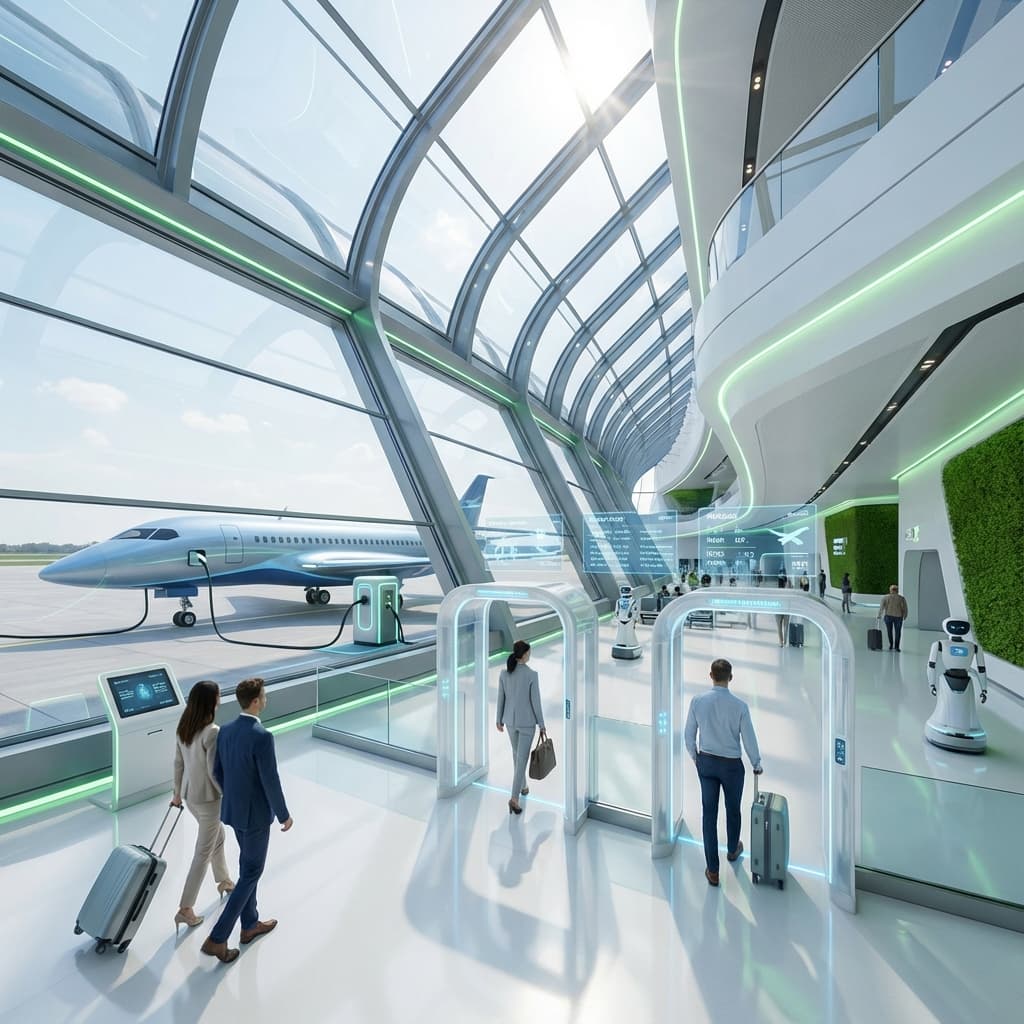
The Future of Air Travel: What to Expect in 2026 and Beyond
For the last 40 years, commercial aviation has basically been the same: a metal tube, a cramped seat, and a bag of pretzels. But we are currently standing on the precipice of the biggest shift since the Jet Age. From security lines that scan your walk to planes that produce zero emissions, flying is about to change—drastically.
1. Your Face is Your Passport
The days of fumbling for your boarding pass and ID are numbered.
Biometric Seamlessness: Airports like Singapore Changi and Dubai are already testing "contactless corridors." You walk from the curb to the plane without stopping. Cameras scan your face, match it to your passport data in the cloud, and open the gates automatically. In the US, TSA PreCheck Touchless ID and Delta's Digital ID are the first steps.
2. The Return of Supersonic
Since the Concorde retired in 2003, we've been stuck at Mach 0.85. Companies like Boom Supersonic are changing that.
- The Promise: New York to London in 3.5 hours. Tokyo to Seattle in 4.5.
- The Difference: Unlike the noisy Concorde, these new jets are designed with "Low Boom" technology, making them quieter and potentially eligible to fly overland. American Airlines and United have already placed orders.
3. The Rise of the "Air Taxi" (eVTOL)
Getting to the airport is often worse than the flight itself. Enter the Electric Vertical Take-Off and Landing aircraft.
Companies like Joby Aviation and Archer are preparing to launch short-range "hops" in cities like NYC and LA. Imagine taking a silent, electric helicopter from Manhattan to JFK for the price of an Uber Black ($150), turning a 90-minute rush hour drive into a 7-minute flight.
4. The "Green" Premium
Sustainability is the industry's biggest existential threat. Or challenge.
Sustainable Aviation Fuel (SAF): Made from cooking oil, waste, or corn. It reduces emissions by 80%. The catch? It costs 3x more than jet fuel. Expect "Green Surcharges" on your ticket prices to become the norm as governments mandate its use.
5. Sleep Pods in Economy
It sounds like a dream, but Air New Zealand's "Skynest" is real.
For the first time, economy passengers can book a 4-hour slot in a lie-flat bunk bed pod during ultra-long-haul flights. It’s a game-changer for flight health, allowing real sleep without the $5,000 business class price tag.
The Privacy Trade-Off
"I tried the biometric boarding in Atlanta. It was undeniably fast. I didn't break stride. But there is a moment of hesitation—realizing that a machine knows exactly who you are, where you are going, and what your 'risk score' is, just by looking at your iris.
The convenience is addictive, but we need to remain vigilant about data privacy. Opting out should always remain a right."
Conclusion
The friction of travel is being eroded by technology. The future is faster, greener, and more personalized.
Whether we will ever get more legroom remains to be seen (probably not), but at least you might get there twice as fast.
About the Author
Aero Smith
Travel Writer
Passionate explorer sharing insights on News and authentic travel experiences.
AI Travel Pulse
Daily Generated Insights
The Rise of 'Silent Travel'
In a hyper-connected world, silent retreats are trending. From Vipassana in India to silent hiking in Finland, travelers are seeking destinations that offer digital detox and absolute quiet to recharge mental batteries.
Powered by TravelGPT-4 • Updated daily at 00:00 UTC
Did you know?
Subscribers to our newsletter get these travel tips delivered directly to their inbox every week. Don't miss out on the latest travel hacks!
Subscribe Now →Browse More Articles
Should You Use Points for Flights or Hotels? The Valuation Guide
February 16, 2026
Are Travel Rewards Easier to Earn Than Cashback? The Velocity Myth
February 14, 2026
Are Travel Agents Better for Luxury Vacations? The 'VIP' Reality
February 13, 2026
Are Travel Refunds Guaranteed? The Rule 240 & DOT Revolution
February 12, 2026
Is Travel Medical Insurance Mandatory for Europe? The 2026 ETIAS Guide
February 11, 2026